

Agentic AI & Autonomous Coding Systems in 2026: The New Engineering Workforce
Why engineering teams are moving from autocomplete copilots to autonomous multi-agent coding systems with self-healing pipelines in 2026.
Read article
A lot of people ask us whether they should build their new app with Flutter or React Native. If you look online, developers fight about this all the time. But having built apps for years, we can tell you that both tools get the job done really well today. The choice comes down to what you are trying to build and what your devs know best.
Back in the day, Flutter used to stutter on iPhone animations, while React Native struggled whenever apps passed too much data across its old bridge. Thankfully, both development teams at Google and Meta have ironed out those early technical hurdles over the last couple of major releases.
Flutter takes a unique approach by painting its own UI elements pixel by pixel through a dedicated graphics engine. That means your buttons and fonts look identical whether someone opens your app on a cheap Android device or a brand new iPhone.
React Native rewrote its core engine to make rendering super fast. For everyday apps with lists, profiles, cart checkouts, and media players, nobody using your app will ever tell if it was written in React Native or native Swift.
Honestly, your internal staffing usually decides this for you.
If your engineers already build web apps with React and TypeScript, choosing React Native makes total sense. They can jump into the mobile code without a massive learning curve and share API logic across web and mobile. Besides that, almost every software engineer knows JavaScript, so recruiting extra help down the road is never a headache.
Flutter works wonders if your app needs cool visual effects, fancy charts, or custom brand styling. Because it draws its own controls instead of using the default Android and iOS buttons, our testers see way fewer weird screen glitches across odd phone models. Also, writing Dart code feels pretty natural for anyone with basic coding experience, so programmers learn it very quickly.
Go with React Native if you already have an in-house team writing React for the web, need to drop mobile views into an existing native app, rely heavily on Apple HealthKit / Bluetooth hardware, or want to hire from a huge pool of JavaScript developers.
Go with Flutter if your product is visual-heavy with custom brand layouts and animations, you want pixel-perfect consistency across hundreds of different Android models, or you want to target mobile and desktop from a single shared codebase.
After shipping apps across both ecosystems at Devlex Infotech in Ahmedabad, here is what we tell our clients: the framework will not make or break your product.
What actually matters is having senior architects who know how to manage memory, write clean offline caching, set up automated CI/CD pipelines, and test across real physical devices. A great team will ship a blazing-fast app in either tool.
If you are still completely torn between the two, build a quick five-day test. Take your single most complicated screen—maybe a custom interactive map or tricky checkout flow—and have your developers code it in both. You will know the answer within five days.
Our architects offer a free 30-minute consultation — no sales pitch, just answers.
Why engineering teams are moving from autocomplete copilots to autonomous multi-agent coding systems with self-healing pipelines in 2026.
Read article
Why rigid tables and static forms are dying, and how generative software renders intent-driven micro-interfaces in real time in 2026.
Read article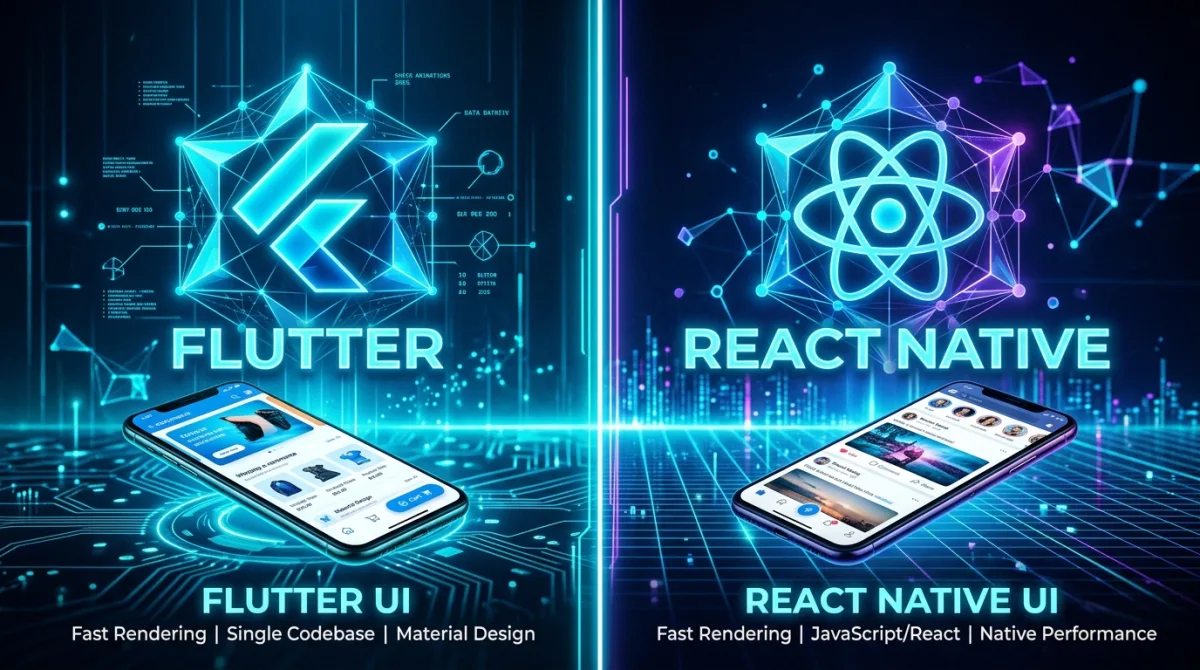
Flutter Impeller vs React Native Fabric benchmarked for 2026: frame rates, cold start times, memory use and AI bridging, with data from real builds.
Read article